
Why Your Belly Pushes Out During Ab Exercises (and How to Fix It)
If your belly pushes outward when you do ab work, it usually means your deep core isn't engaged enough to support the movement. Instead of your abdominal wall drawing in and stabilizing you, pressure pushes it forward, and that's often why the lower belly pooch sticks around no matter how many crunches you do.
The good news is that the fix is less about doing more and more about changing how you breathe and brace before you move.
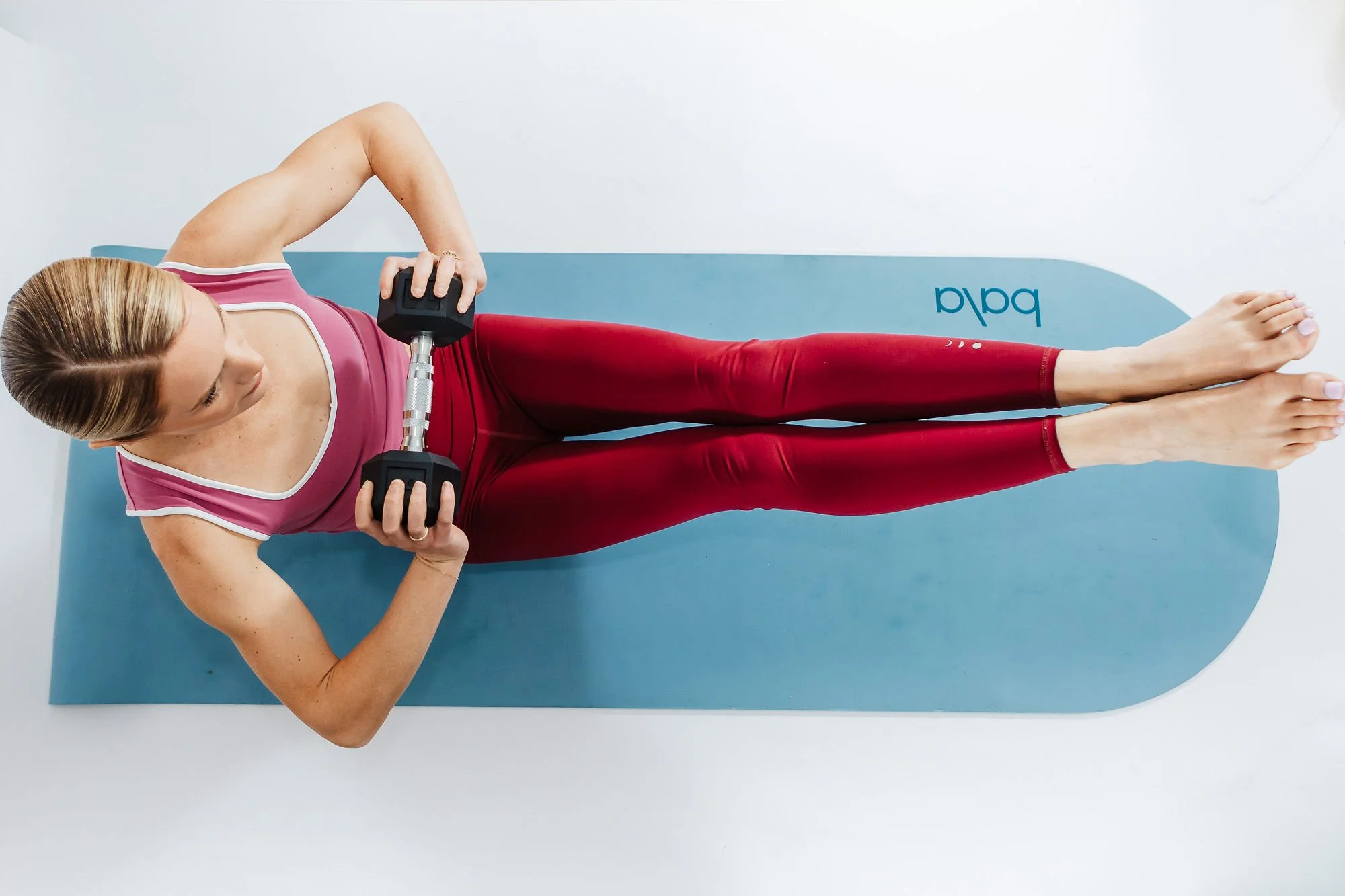
What that bulge is actually telling you
Next time you're doing a crunch, leg lift, or any exercise where you're lying on your back, take a look at your stomach. If it rises up into a dome, a ridge, or a tent shape down the middle, that's a sign the pressure inside your abdomen has nowhere better to go. Your deepest core muscle, the transverse abdominis, works like a natural corset that wraps around your midsection. When it's switched on, your belly stays flat or gently draws in as you work. When it isn't, the more superficial muscles do the heavy lifting and your belly gets pushed outward.
This is especially common after pregnancy or a C-section, when the abdominal wall has been stretched, cut through, or simply out of practice for months. A lot of my clients tell me they went back to the ab routines they did before baby and couldn't understand why their stomach looked worse instead of better. Repeating reps with that outward push doesn't build the support you're looking for, and over time it can keep the pooch hanging around.
The fix: engage, exhale, then move
Before you change anything else about your workout, change the order of operations. Start by gently drawing your belly up and in, as if you're zipping up a snug pair of jeans from your pelvic floor to your belly button. This shouldn't feel like sucking in hard or holding your breath. Think of it as a light, steady lift.
From there, exhale. Your breath is one of the most useful tools you have for managing pressure, and exhaling as you exert helps your deep core and pelvic floor work together instead of against each other.
Only then do you move, and slowly. Speed hides a lot of compensation, so taking each rep at a controlled pace lets you actually see whether your belly is staying flat. If it starts to push out partway through, that's your cue to stop the rep, reset, and try again with a smaller range of motion.
When to scale it back
If you're engaging, exhaling, and moving slowly and you still see a ridge or bulge running down the middle of your stomach, it's time to scale back. That might mean swapping crunches and full leg lifts for gentler moves like heel slides, dead bug variations with your feet on the floor, or simple breathing drills where you practice that up-and-in engagement without any added load.
A persistent ridge down the midline can be a sign of diastasis recti, which is a separation of the two sides of your rectus abdominis (your "six pack" muscles) along the connective tissue that joins them. It's very common during and after pregnancy, and it isn't something to panic about, but it does change how you should approach core training. If you suspect it, a pelvic floor physical therapist can assess the gap and guide you on what's safe for your body.
Working smarter, not harder
It's easy to assume a stubborn lower belly means you need to push harder, but the opposite is usually true. Fewer, slower, well-supported reps will do more for your core than dozens of rushed ones where your belly is pushing out the whole time. Once you learn what real deep core engagement feels like, every exercise becomes more effective, and that's when you start to see your midsection feel flatter and stronger.
Movement is only one piece of the picture, too. What you eat plays a role in how your belly looks and feels day to day, and that's worth paying attention to alongside your training.
That said, figuring this out on your own can be frustrating, especially if you're healing from pregnancy, a C-section, or diastasis recti and aren't sure what's safe. This is exactly the kind of work I do with clients in Methods coaching. Together we build a plan around where your body is right now, from rebuilding deep core strength to training and nutrition that fit your real life, so you're not left guessing whether you're helping or hurting your progress. If you're ready for that kind of support, you can apply to work with me here.
